
Saturday, September 16, 2006

Reinventing the Middle East ... and more

Hmmm... Ralph Peters has an interesting concept of what a future Middle East could look like. Among other things, he proposes new nations like an Arab Shia state, "Free Baluchistan," and "Greater Kurdistan," and the "Islamic Sacred State;" significantly enlarged Afghanistan, Azerbaijan, and Yemen; and significantly shrunken Turkey, Iran, Pakistan and Saudi Arabia.

Some of those things make sense, some don't.

Truthfully, I've thought along those lines, too. Being a map buff, I've played with maps of the tribes and languages in that area to craft an alternate Middle East, and it shares a few points with Peters. For example, I also came up with Kurdistan and Baluchistan, but his vision of a mega-Afghanistan makes no sense culturally. That nation even as it is today is a mess of peoples that don't function as a nation. It's Pashtun, Hazara, Tajik, Kyrgyz & other groups often don't share linguistic or cultural heritage. Some of them have significant numbers of their tribe in neighboring nations (namely, Pashtuns, who are also numerous in Pakistan, and Tajiks & Kyrgyz, who have their own countries), while others are seriously discriminated against (namely, the Hazara).

He leaves a rump Pakistan that has little cultural history at all -- the only reason Pakistan exists today is that it defined itself by its Muslim majority in the 1940s, after British India threw off London's yoke and Gandhi got assassinated. A real split based on cultural lines would eliminate Pakistan entirely, giving some (mostly the western regions) to other countries (above) and unifying the bulk of its people into what was, before and somewhat during British rule, a resurrected state of Punjab, which would include part of NW India.

Speaking of India, I think it's interesting that Peters only targets MUSLIM nations for dismemberment. Hindu India is the world's biggest polyglot nation, with literally hundreds of linguistic minorities and a history of being divided into many co-existing (and sometimes warring) nation-states. The nation's disunity stretches back millennia, to the days the first Indo-European tribes migrated from the north and settled in the Ganges valley, but left a large Dravidian population in the south.

To be sure, India has been unified numerous times in its history, but that unity was often a surface unity only, with urban areas (especially the Ganges Valley) accepting whatever the current imperial dynasty was but tribal areas (especially in the south) rejecting him. A great example is Ashoka's Empire, possibly the greatest Indian emperor. The top map is how his realm is typically depicted in historical atlases, but the bottom shows how puzzle-like it really was.

The fact that India is today a functioning democracy is largely despite those centrifugal pressures, but we still see them emerge at times. Today's most notable example is the Tamil Tiger revolt in Sri Lanka, where the Sinhalese Buddhist majority is trying to prevent the Tamil Hindu minority from slicing off the nation's NE third. Those Tamils have a significant presence on the Indian mainland, being a large majority in the state that bears their name, Tamil Nadu.

In some respects, I think Peters' proposal is merely a reflection of the current trend away from big nation-states and towards more ethnically-homogenous entities. Although he's unfortunately correct when he says that 5,000 years of experience shows that ethnic cleaning works, as we've seen in the Balkans and Iraq, I don't think a resurrection of tribalism or regionalism HAS to involve mass murder, as the mostly peaceful breakup of Czechoslovakia and the USSR proved.

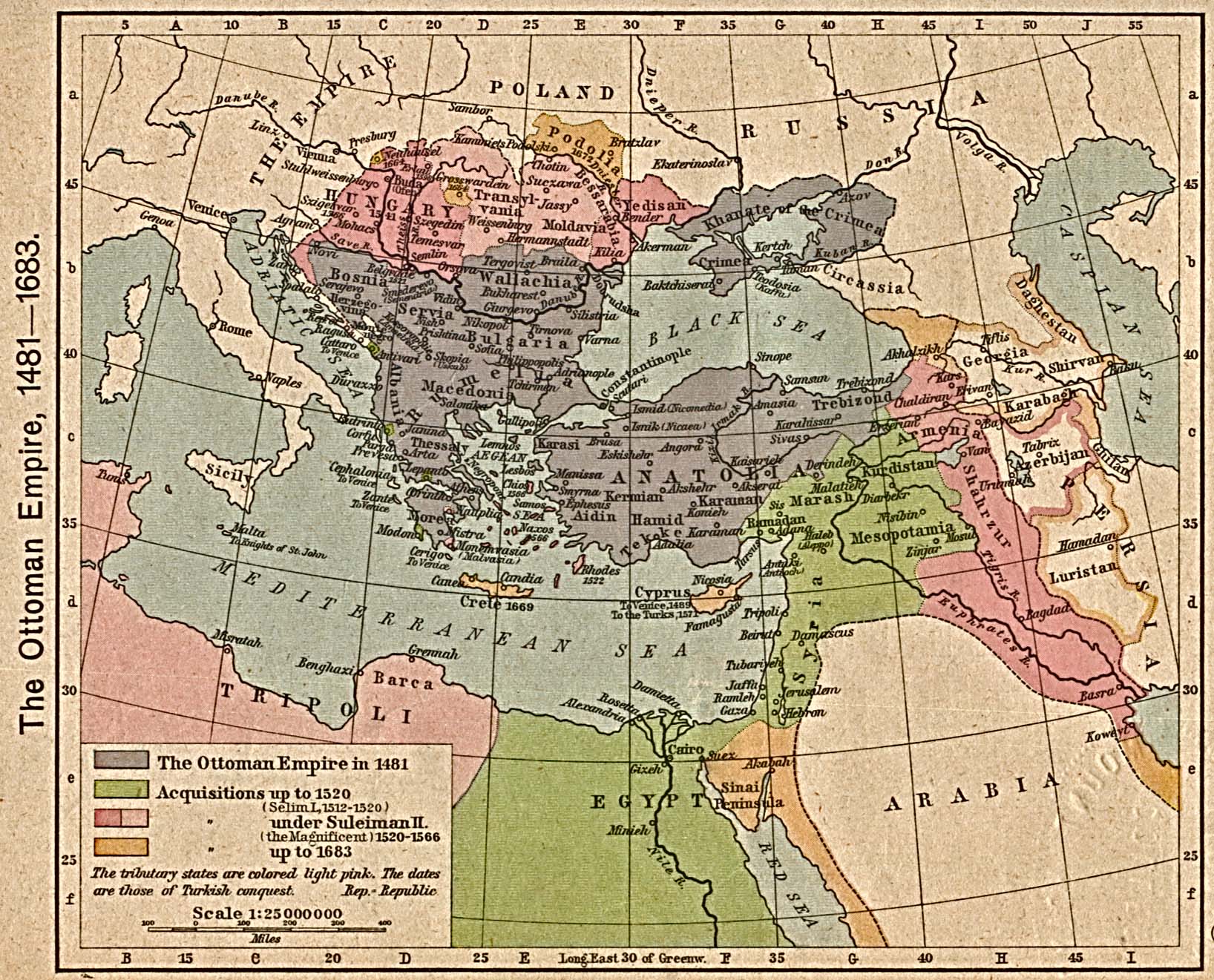
In some cases, such breakups would probably be beneficial in the long run. Take Turkey: Why does Ankara WANT to keep the fractious Kurds in the country? Why not let them form their own nation and wash Turkish hands of the problems caused by the feuds with PKK & similar groups? The primary reason is probably a vestige of Turkish memory of imperial glory, since the Kurds are the last remnant of the dozens of nationalities the Ottoman Empire ruled for centuries. But the more practical reason I can think of is water -- the Kurdish population resides in the highlands that spawn the Tigris & Euphrates rivers, while most of Turkey itself is semi-desert. An independent Kurdistan would be a major regional player for that reason (not to mention oil wells near Kirkuk & Mosul).
At times, I think this concept should be extended to the US, too. As time goes by, it seems like the liberal, cosmopolitan Northeast and Pacific coasts seem to be sliding away from the conservative, more segregated South and central states in attitude, education, religiosity, dialect, and various other factors. Are we seeing the development of new cultures? Probably; every major state in history (except maybe China) has given birth to new societies rooted in the old one. Many of those spin-offs happened violently, either by invasion or revolution, but we can't afford that today.

Instead, maybe it's time for the people of various states and regions to consider whether their interests are truly best served by being part of a federal America, or whether democracy is best served by having several countries and maintaining friendly contact via modern communications technology and family ties, but not political ones. There's no reason the US couldn't be similar to Europe, with several independent nations linked together by economy, geography, shared interests, and more-or-less open borders to travel and commerce. I think smaller states enable people to watch over and participate in government more easily and are therefore able to be more genuinely small-d democratic. Since this is likely to happen in time anyway, we might as well manage it consciously so as to ensure as much as possible that the outcome is peaceful and orderly. Otherwise, history shows it's very likely to be bloody and chaotic.

Thanks to Kelly at Singularity for the tip.

Labels: , ,

Sunday, July 23, 2006

A look at the past... or future?

Not far from where I live, the towns of Dana, Greenwich, Enfield and Prescott were evacuated to make way for Quabbin Reservoir in 1938. The people were scattered among various other communities, their houses removed except for the foundations, their cemeteries transplanted, their way of life completely re-arranged. The acreage of the towns themselves -- what isn't now underwater -- was ostensibly annexed to neighboring towns, but much of it is state-owned conservation land protecting the reservoir's feeder streams. Even a railroad and state Route 21 that used to serve that area are gone.

The maps are quite telling (look in the lower right-hand corner): 1938 vs 1939.

Today, I visited what used to be Dana Center. It's accessible by way of a generally passable, still paved road that's closed to car traffic, with grass and moss growing through the cracks and potholes. (On the 1909 map (the first link above), that's the route from Nichewaug through Dana and down along Pottapaug Pond, which still exists as a de facto arm of Quabbin.) A hike of a mile or so through forest that's still reclaiming old farmland at the edges takes you past a modern portajohn, a couple of small trails leading to stone house foundations, a locked hut containing some old signs, and a big rock outcrop I first thought had a stone wall atop it, but found to be a great place to write.

Typical of New England towns, Dana Center had several buildings focused on the town common. I can only guess at what they were from their foundations & my knowledge of NE towns, but I presume the one on the north side, fronted by horse hitching posts, was Town Hall, the one on the west side was a church, and those to the south were houses or shops (or both). The only modern element of the scenery is a stone memorial reading "Site of Dana Common 1801-1938. To all those who sacrificed their homes and way of life. Erected by Dana Reunion 1996."

What did those reunion folks think when they saw the foundations of their homes after all these years? How did that differ from the ideas of their kids and grandkids, who never knew Dana as even a place on the map?

Part of me wishes the reunion folks had also erected something (say a diorama) that would give visitors a guide to who owned the homes and what the Common area really looked like then. But most of me is glad they didn't -- this way we get to see what really happens when nature reclaims things. Dana 2006 is a nice escape from modern society -- lots of sound, but all of it wild: birds of various kinds, bubbling brooks, fish gulping insects on the reservoir's surface, wind in the leaves. The only sound of civilization is a passing plane; this place is far enough in the boonies you can't even hear cars on the nearest state highway.

In some respects, especially with the nonsense going on in the Middle East bringing to mind questions of what kind of future we'll have, walking through Dana today could be a tour of the past or a premonition of the future. Will there be a time when our descendents walk through modern-day towns and see them being overgrown or even crumbling in ruins? If so, why? Will it be because we consciously chose to move to cities or to reduce our population, because some illness struck many of us down, or because we went nuts and decimated ourselves in some brutal manner?

We'll find out ... maybe in the near future.

Labels: , ,

Sunday, February 19, 2006

by fire and ice and ...

The Life and Death of Planet Earth
By Peter Ward and Donald Brownlee
Henry Holt/Times Books, 2002

RATING: **1/2 (of 5)

How many ways can the Earth end?

Probably more than anyone with anything less than a (slight) obsession with the concept is willing to consider.

Just so happens, I guess I have such an obsession, at times anyway. So do Ward and Brownlee, who spend over 200 pages exploring just about every possible doom the Earth will eventually face over the next 6-8 billion years.

Before I get into analyzing what they say, I'll give a quick timeline as they see it (not quoted from them, but culled from various places in their book. The quotebox layout is simply for display. All dates, obviously, are estimates.):

Next few centuries: Global warming sparked in part by human actions.
2-10 MY: Ice Age resumes, with periods of warming just like last million-plus years.
100 MY: Continents begin to re-coalesce into a new Pangaea.
250 MY: New Pangaea firmly established, with extremely arid interior and stagnant oceans, sparking large-scale extinctions.
500 MY - 1 BY: Solar warming moves habitable zone beyond Earth's orbit.
500-700 MY: Plant photosynthesis ends as CO2 levels gradually fall below 10 ppm, with periods of oscillating plant expansion and dieoff; growing heat causes life to retreat to poles.
approx. 15 MY after that: Atmospheric O2 levels have fallen to about 1% of present, extinguishing what's left of animal life. Beyond 60 deg. C, only bacteria, algae and some fungi survive.
1 -1.2 BY: global mean temp. is about 70 deg. C. Oceans begin evaporating, causing the "moist greenhouse effect" that features brutal storms. Plate tectonics comes to a halt from lack of water, eventually resulting in a global ocean. Last bacteria fry around 235 deg. F. @
2.5 - 3.5 BY: "Runaway greenhouse effect" takes over at about 200 deg. C, after all water is gone. Earth becomes like Venus.
3 - 4 BY: Andromeda Galaxy (M31) merges with Milky Way. Gravity and other forces might sling solar system into deep space, or might not.
6 - 7 BY: Sun expands to giant size, possibly reaching Earth orbit. Solar effects cause Moon to swirl back to collision with Earth & possibly cause Earth to spiral into Sun. If not, Earth ends up scorched cinder orbiting white dwarf after Sun goes nova.

Whew. Anything I left out?

Oh, yeah, the "accidental armageddon" causing events -- huge comets or asteroids (it took one about 10 km across to cause the K/T extinction 65 MY ago, and would take one about 100 km across to sterilize all life) or supernovae in the galactic neighborhood (think Sirius; when it goes, its gamma rays will have some serious effect on everything within about 30 light years. We're 12 LY away).

This catalog makes nuclear war look like a game...

Now, I can't realistically refute most of what they say; it seems pretty plausible that, essentially, Earth's life path from here on will retrace its path of the last 4.5 BY, as they propose. But I do take issue with some of their assertions within the various future periods.

First off, obviously, is the near future. There, they allege that the combination of global warming and subsequent ice age return will cause survivors to be "starving" even "thousands of years forward." I strongly doubt that; human gene-lines flexible enough to survive the coming few centuries will have adapted to the new conditions and created or found new food sources. Yes, the short-term will probably see extensive starvation as our ability to fuel modern agriculture runs dry (assuming we don't get our collective head out of our ass very soon and change gears completely), but the population will eventually decline to a stable level. I suspect we'll still have agriculture in some places, maybe even cities, but having people recall what the Space Needle or global warming is (p.71) after a few thousand years is nonsense.

The resumption of ice age doesn't mean civilization has to vanish, although there's little doubt large swaths of the planet will be inhabitable only by the most intrepid folks, as in Antartica today. I could see people having outposts on the ice caps, even towns if we have the foresight to plan technology for that purpose. I'm not the first to think of this, BTW; Michael Kube-McDowell envisioned the Weichsel people with whole cities on the ice, and even an ice-based construction technology, in his novel Empery.

It will, however, mean major changes. Most humans will have no choice but to retreat toward the equator and change how, where, and maybe even what we farm, but I think we're capable of that. Earth will be a drier place, but we've lived through such times before. We can do it the same way we did it then -- by having very dispersed paleolithic-sized (or maybe medieval) populations or by taking the genuinely global outlook that is today struggling to be born and nurturing it. The former would be a likely consequence of nations feuding over dwindling resources; the latter is the only way to face our future and still retain those elements of civilization that are actually beneficial. Not all of them are.

What we do and which elements we keep may determine how long humanity survives as a species, because events AFTER the ice age are likely to be far less hospitable, if Ward and Brownlee are right.

As they note, "we must either take steps to sustain the habitability of our own world or find another at a younger stage of planetary life. ...If we can't engineer or evolve our way around our planet's inevitable decline, then we'd better go planet shopping." (21-22).

The former is, is the sense of planetary time, a band-aid approach -- it's necessary if WE want to stay alive over the short-term, but won't have much effect on life's overall path; only planet-hopping can keep us alive indefinitely, if that's even possible or desirable. In general, I think it is, at least for the next several millennia; as I've said elsewhere, it's necessary if we want to evolve AND maintain civilization. The neo-paleolithic option above will allow for evolution, but not civilization.

If finding other living worlds proves to be effectively impossible, survival will require us to change our attitude to one that sees our talents as being in the service of Earth-life as a whole -- a change we really need to make anyway, since other Earths won't be accessible for a long time.

This outlook flies in the face of a thread that pops up occasionally in this book. On several occasions, Ward & Brownlee express a clearly biased view of other lifeforms. For example, they note "human-level intelligence and technology would never develop on a water-covered planet. There would be neither the need nor the opportunity" (31) -- How would they know? This assertion might be true of technology, but not necessarily true of intelligence; they admit whales and dolphins have "large brains and some level of sophisticated communication," but aren't willing to acknowledge that much of our complexity is cultural, not due to basic intelligence. We have the advantage of being FIRST, but not (hopefully) the only Earthlife to become technological; I strongly suspect we can help other species to do at least some of what we've done.

Elsewhere, they attribute the fact that our current climate "norm is not normal" (79) to long-term causes -- a 70 MY greenhouse gas cycle, orbital cycles#, and continental drift (specifically, the creation of a land bridge between North and South America). While all are indeed factors, they never mention a factor that at least needs to be considered because it's far more timely -- agriculture. Starting just after the Wisconsin/Wurm glaciers receded, people made major changes to the tree cover around the world in an accelerating manner. Apparently, the use of fossil fuels for 150 yrs or so will have a long-term climate effect more profound than 10,000 yrs of slash-and-burn agriculture? That may be true, but evidence would be far better than simply asserting it as fact.

Speaking of evidence, their attribution of sources seems very unprofessional. Yes, they have a pretty lengthy bibliography, but have almost NO references within their text: No footnotes (except to some photos), no direct quotes, and few references to other scientists by name. In several places, I found comments that were clearly referring to something they'd read, but there's no way to actually find out what that was without reading EVERY bibliography source. In some cases, I've seen sources that contradict them (for example, they assert that Ice Age America included "huge deserts and sand dunes" (74), but an Oak Ridge Nat'l Lab map I've seen says only one pocket of America was sandy desert then), and I'd love to see their source. Same's true of their core point that earth's biological fecundity peaked around 300 MY ago and is now slowly declining; Science Daily says the oceans experienced a huge peak 4-6 MY ago.

While I understand they're writing for a popular audience, that's not an excuse for inaccuracy and dumbing down the text. They have a lot of material to work with and the thesis makes sense, but the inaccuracy, occasional redundancy, and spots of arrogance only weaken their ideas.

________________

@ -- This figure is how they wrote it (it stood out as one of two Fahrenheit references, p. 143, amid all of the other Celsius and metric references. I'm not sure if they meant F or C, but there is a significant difference between them.) For scientists, their phrasing is woefully imprecise in other places, too. On p. 34, they write, "Earth's proportion of water to its weight is small ... less than one-tenth of one percent." Weight means nothing in science; the term is mass, and that figure is accurate, but WAY off -- the actual figure is 1/50 of a percent (.023%), if I'm calculating the figures here properly. Saying that is similar to saying "Earth's population is less than 30 billion" -- true, but it gives an extremely distorted impression of the facts.

# -- There are three orbital cycles -- of 95,000, 41,000, and 22,000 yrs. Regarding the first of these, they contradict themselves. On p. 80, they say we're currently at a position where Earth's orbit is closest to the Sun in January and farthest in July, meaning that "summer [sic] snows may last longer than the long-term norm." On p. 82, they note that a previous interglacial (i.e. WARM period) was at a time when "orbital eccentricity was at a minimum" and "just such a pattern of minimal orbital eccentricity is underway now." Huh?!? Only one of those assertions can be correct. For more info, see the Naval Observatory's orbital cycles page.

Labels: , , ,

Saturday, September 03, 2005

this was predicted... years ago

Before I vent a little steam, let me suggest an idea my girlfriend came up with to help the stranded people in N.O: Have the various cruise ship lines send their ships to the city to provide floating housing. It'd be a lot more comfortable than the Astrodome or any other refugee camp, and would also serve as a form of transportation for maybe 1,000 people per ship (far more than any bus!). Maybe they could then arrange to take the groups to various cities nationwide so that the cost of helping them doesn't all fall on one region.

I understand the Navy is sending a carrier there, and that would provide space for many more people than a cruise ship, but the Navy's noted for pretty spartan accomodations. Given how much these people have already suffered and the poverty many of them have been facing for years, it's long since time they got treated well for once.

OK, now for the rant:

Anyone who's awake is sad at the suffering in New Orleans and/or mad at the fact that this could have been prevented. Obviously, Katrina herself couldn't have been, but the fact that N.O. flooded could have.

The following comes from National Geographic, Oct. 2004 (yes, 2004):

Thousands drowned in the murky brew that was soon contaminated by sewage and industrial waste. Thousands more who survived the flood later perished from dehydration and disease as they waited to be rescued. It took two months to pump the city dry, and by then the Big Easy was buried under a blanket of putrid sediment, a million people were homeless, and 50,000 were dead. It was the worst natural disaster in the history of the United States.

When did this calamity happen? It hasn't—yet. But the doomsday scenario is not far-fetched. The Federal Emergency Management Agency lists a hurricane strike on New Orleans as one of the most dire threats to the nation, up there with a large earthquake in California or a terrorist attack on New York City. Even the Red Cross no longer opens hurricane shelters in the city, claiming the risk to its workers is too great.

"The killer for Louisiana is a Category Three storm at 72 hours before landfall that becomes a Category Four at 48 hours and a Category Five at 24 hours—coming from the worst direction," says Joe Suhayda, a retired coastal engineer at Louisiana State University who has spent 30 years studying the coast. Suhayda is sitting in a lakefront restaurant on an actual August afternoon sipping lemonade and talking about the chinks in the city's hurricane armor. "I don't think people realize how precarious we are,"
(Hurricane expert Joe) Suhayda says, watching sailboats glide by. "Our technology is great when it works. But when it fails, it's going to make things much worse."


Suhayda also comments in some depth in this PBS transcript from 2002.

Also, they had a "dry run" of this last year, with Hurricane Ivan, and apparently learned nothing...

Of course, Bush doesn't bother to read, especially anything that might have some semblance of science behind it. Instead, he told the world Tuesday he'd magnanimously cut his vacation short on FRIDAY, and when he did go to N.O., he flew OVER the city, but didn't bother to land in it. Any REAL leader would've gotten off his ass immediately and taken the next possible flight there. (Same's true of Dick(head) Cheney -- he apparently doesn't feel the loss of an American city by "merely" natural catastrophe is enough to even tell the country where he IS for six days. SO, wait... If BOTH Bush and Cheney are vacationing at the same time... who is running the show?!?

Oh, BTW, he apparently believes he can shut down food deliveries at will, :

Bush visit halts food delivery
By Michelle Krupa
Staff writer

NEW ORLEANS TIMES-PICAYUNE

Three tons of food ready for delivery by air to refugees in St. Bernard Parish and on Algiers Point sat on the Crescent City Connection bridge Friday afternoon as air traffic was halted because of President Bush’s visit to New Orleans, officials said.

The provisions, secured by U.S. Rep. Charlie Melancon, D-Napoleonville, and state Agriculture Commissioner Bob Odom, baked in the afternoon sun as Bush surveyed damage across southeast Louisiana five days after Katrina made landfall as a Category 4 storm, said Melancon’s chief of staff, Casey O’Shea.

“We had arrangements to airlift food by helicopter to these folks, and now the food is sitting in trucks because they won’t let helicopters fly,” O’Shea said Friday afternoon.

The food was expected to be in the hands of storm survivors after the president left the devastated region Friday night, he said.


The more this goes on, the more convinced I am that Bush and others who took funds from the Army Corps of Engineers' plans to strengthen the levees should be prosecuted for the deaths the flooding and chaos have caused -- many counts of negligent homicide, at least. Politically speaking, Bush is a kind of father figure, and his treatment of the American people can be considered neglect, at best. Any real father who was warned that his children were in a situation that would harm them but did nothing about it would be prosecuted, and so should Bush & Cheney.

Oh, and if THAT's not enough to be pissed about, the Houston Chronicle reported that Halliburton is making money off the disaster by cleaing up the region's Navy facilities.

!@#$%^&&*^%$#@!!!!!

OK. Enough venting for now.

If you haven't already visited them, here are a couple of good sites on the unfolding crisis in The Big (Un)easy:

The Tattered Coat
The Interdictor
Broken Windows
Larry King interview re: Red Cross not being allowed into N.O.

And a list of major places to donate here. but if you go here, PLEASE ignore "Operation Blessing." That's terrorist preacher Pat Robertson's outfit, and if that's not enough reason to avoid it, see this.

Labels: , ,

Thursday, August 18, 2005

African hunters on US plains?

Today, the BBC ran an interesting story -- Cornell University scientists are seriously considering the idea of importing cheetahs, lions, wild horses, elephants and other big lifeforms to run wild on the Great Plains.

By introducing living counterparts to the extinct animals, the researchers say, these voids could be filled. So, by introducing free-ranging African cheetahs to the Southwest, strong interactions with pronghorns could be restored, while providing cheetahs with a new habitat. ...

Other living species that could "stand in" for Pleistocene-era animals in North America include feral horses (Equus caballus), wild asses (E. asinus), Bactrian camels (Camelus bactrianus), Asian (Elephas maximus) and African (Loxodonta africana) elephants and lions (Panthera leo).

"Obviously, gaining public acceptance is going to be a huge issue, especially when you talk about reintroducing predators," said lead author Josh Donlan, of Cornell University. "There are going to have to be some major attitude shifts. That includes realising predation is a natural role, and that people are going to have to take precautions."


Yeah, Dr. Donlan, it'll be a huge issue. Did you forgot that this is part of the country where people still object to the idea of reintroducing native predators like wolves... by killing them? Or that the big native herbivore, the bison, still only counts a small number of wild survivors in pockets of what was once a vast range, the vast majority being raised on private ranches?

I agree that average people need to learn that predation is a necessary part of the ecosystem, but we should focus on re-establishing the wolves first. I suspect introducing African species won't result in filling the voids, it will create more problems for a native species' population web that has stabilized without them. They have, after all, been gone around 13,000 years. While that time isn't enough to create significant genetic changes, it has certainly allowed for some behavioral adaptation that new predators will upset. Besides, the newcomers would most likely go after the easiest prey they can find... namely, domestic cattle. Why chase down an antelope at 60 mph when you can munch on much slower fare?

That said, I think the effort to save African species is important and the image of lions stalking prey in sight of New Mexico's I-40 would be an interesting one. But how would they react to the traffic? Today, their homeland has cars, sure, but not the kind of freeway network or the sheer traffic volume the US has. Likewise, these animals come from a climate that tends to be warmer than our plains are; although summers would probably be just fine, how well would they adapt to the Chinook blizzards of winter if they lived in Nebraska or Kansas? In Africa, some of them migrate seasonally, but that would be a problem on our Plains because of the fact that so much land is fenced up into farms and ranches, likely requiring those who get released in one area to stay there.

It's pretty obvious to me that this idea needs a little rethinking.

Labels: ,

Monday, July 25, 2005

Hiroshima redux

This week's Guardian has an incredible spread on the 60th anniversary of the Hiroshima & Nagasaki bombings, with an edited version of John Hersey's original article (later lengthened into the book Hiroshima), interviews with survivors who were then kids, etc. Be sure to read the various articles linked to part two.

Once done... write your senators, congressmen, etc., telling them to stop the madness and oppose new nuclear weapons. We can and should make changes now... but part of me is afraid it'll take another Hiroshima before we do and that if that happens it won't just be one or two cities. Prove me wrong.

Labels: ,

Tuesday, June 21, 2005

Nagasaki pt 2

Aha, I was looking for this. George Weller's original stories as published by the Japanese Mainichi Daily News, based on his notes. There are some weird phrasings and several notations that words are illegible. Given what we now know about nukes, they seem curiously out-dated, and Weller phrases some things in ways that strike me as not being journalistically neutral, but they're an interesting insight into an outsiders view of holocaust on a small scale.

Labels: ,

Nagasaki

Banned A-bomb horror reports found (emphasis added)

KENJI HALL
IN TOKYO

SOURCE: The Scotsman 6/20/05

CENSORED reports of the devastation caused by the Second World War atomic bomb dropped on the Japanese city of Nagasaki have been rediscovered 60 years after they were suppressed on the orders of US General Douglas MacArthur.

Award-winning reporter George Weller sneaked into the country - despite a ban on journalists - to provide an unflinching account of the "wasteland of war" and the horrific illnesses caused by radiation.

Mr Weller, who died in 2002, posed as a US Army colonel at one point to get into Japan in early September, about three weeks after the nation surrendered and a month after the Hiroshima and Nagasaki bombs.

Carbon copies of his stories, running to about 25,000 words on 75 typed pages - along with more than two dozen photographs - were discovered by his son, novelist Anthony Weller, at his father's flat near Rome.

The stories infuriated General MacArthur so much that he personally ordered that they be quashed, and the originals were never returned.

About 70,000 people were killed in the explosion in Nagasaki, and Anthony Weller said he thought wartime officials wanted to cover up stories about radiation sickness and feared his father's reports would sway American public opinion against building an arsenal of nuclear bombs.

In an article dated 8 September 1945, Mr Weller, who submitted his work to the US censors, told how he walked through the city.

Though thousands of burn victims had died within a week after the attack, doctors were stumped by "this mysterious disease X" which was still killing many Japanese people and also Allied soldiers freed from prison camps a month later.

"In flattened skeletons of the Mitsubishi arms plants is revealed what the atomic bomb can do to steel and stone, but what the riven atom can do against human flesh and bone lies hidden in two hospitals of downtown Nagasaki," he wrote.

One woman at a hospital "lies moaning with a blackish mouth stiff as though with lockjaw and unable to utter clear words", her legs and arms covered with red spots.

Others suffered from a dangerously high fever, a drop in white and red blood cells, swelling in the throat, sores, vomiting, diarrhoea, internal bleeding or loss of hair, Mr Weller wrote.

The next day, he met a Japanese doctor and X-ray specialist who thought the bomb had showered the population with harmfully high levels of beta and gamma radiation. But nobody could say for sure.

The journalist was 95 when he died in December 2002 at his home in San Felice Circeo, Italy.

He won the Pulitzer Prize, the most prestigious journalism prize in the United States, for an eyewitness account of an emergency appendectomy carried out by a pharmacist's mate on a Navy submarine underwater in the South China Sea.

*******

Other stories of that event & Hiroshima:

BBC's original 1945 coverage

Common Dreams' look at the real story and the propaganda machine that tried to suppress it.

Yale's Avalon Project, Chap. 7 reports something I didn't know, buried in several chapters of pretty generic stuff about both Hiroshima and Nagasaki:

"During the approach to the target the special instruments installed in the plane told us that the bomb was ready to function. We were prepared to drop the second atomic bomb on Japan. But fate was against us, for the target was completely obscured by smoke and haze. Three times we attempted bombing runs, but without success. Then with anti-aircraft fire bursting around us and with a number of enemy fighters coming up after us, we headed for our secondary target, Nagasaki.

What was their PRIMARY target? According to Wikipedia it was Kokura, now part of the city of Kitakyushu (2005 pop. almost 1 million). It was probably chosen because of its status as a transport hub between Honshu and Kyushu plus the fact that it is HQ of Nippon Steel Corp., obviously a major player in Japan's wartime economy. I just wonder if anyone noticed the irony of the fact that one of its sister cities today is Norfolk, VA -- a major US Navy nuclear sub base. "The expression Kokura's luck became common in Japan for escaping a horrible situation without being aware of it."

About.com has the following grim memory from survivor Fujie Urata Matsumoto:

The pumpkin field in front of the house was blown clean. Nothing was left of the whole thick crop, except that in place of the pumpkins there was a woman's head. I looked at the face to see if I knew her. It was a woman of about forty. She must have been from another part of town - I had never seen her around here. A gold tooth gleamed in the wide-open mouth. A handful of singed hair hung down from the left temple over her cheek, dangling in her mouth. Her eyelids were drawn up, showing black holes where the eyes had been burned out. . . . She had probably looked square into the flash and gotten her eyeballs burned.

For more survivors' stories, go here... or for their artwork, go here.

If those aren't enough to show that banning the bomb is the only sane course we can take, what kind of evidence does it take???

Labels: ,